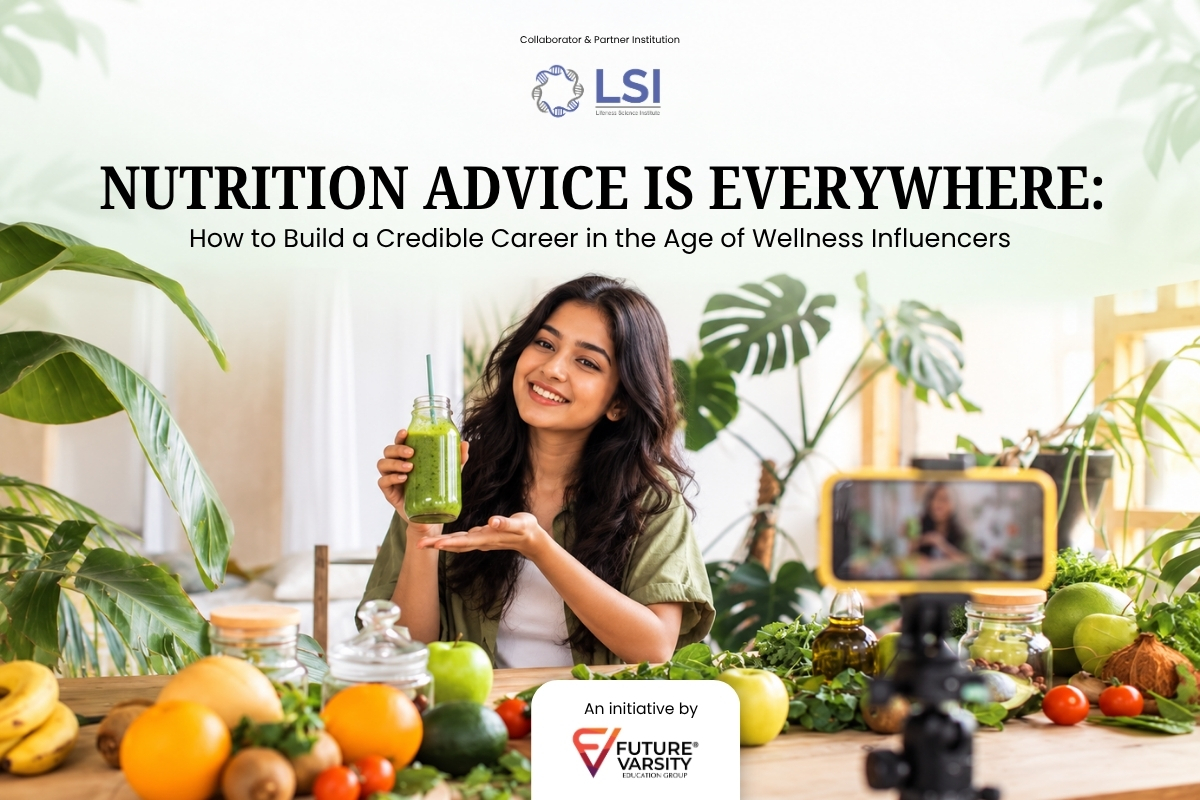
A smartphone can turn almost anyone into a publisher, but it cannot automatically turn someone into a qualified nutrition professional.
Every day, social media platforms are filled with nutrition advice, diet trends, food recommendations, wellness routines and health-related claims. While digital platforms have made nutrition information more accessible, they have also made it harder for consumers to distinguish between professional guidance, personal experience and unverified advice.
For students considering a career in nutrition, this creates both a challenge and an opportunity.
The challenge is standing out in an environment where everyone appears to have an opinion about food and health. The opportunity is to build something that cannot be created overnight: professional credibility.
What Does It Take to Build a Career in Nutrition?
A credible nutrition career starts with education.
Nutrition is a multidisciplinary field involving areas such as biochemistry, physiology, food science, nutrition assessment, health and disease, behaviour and lifestyle.
Structured education helps students develop a scientific foundation and understand why nutrition recommendations can differ depending on an individual’s needs, health status, lifestyle and goals.
For students asking how to become a nutritionist in India, choosing an appropriate nutrition and dietetics programme is therefore one of the most important starting points.
However, academic knowledge is only one part of becoming a well-rounded professional.
Credibility Starts With Strong Foundations
A professional needs to understand the science behind the recommendation, not simply memorise what is currently popular.
A strong educational foundation can help students understand:
- Human nutrition and metabolism
- Food science and dietary patterns
- Nutrition assessment
- Human physiology
- Lifestyle and behaviour
- Research and evidence
- Nutrition across different populations
- Communication and counselling
This foundation allows future professionals to ask an important question before accepting a nutrition claim:
What is the evidence behind it?
That question is becoming increasingly important in the age of wellness influencers.
Communication Is Part of Professional Competence
Knowing the science is important. Being able to explain it is equally valuable.
Nutrition professionals interact with individuals, families, communities, organisations and increasingly, digital audiences. They need to communicate complex concepts without unnecessarily complicating them.
Future professionals can develop communication skills through:
- Writing educational content
- Practising counselling conversations
- Presenting scientific concepts
- Creating responsible digital content
- Developing consumer education materials
- Explaining research in accessible language
Clear communication can also help address misinformation without creating unnecessary fear or judgement.
The goal should not be to simply tell people that they are wrong. It should be to help them understand what the evidence actually says.
Build an Evidence-Based Nutrition Habit
One of the most valuable habits a nutrition student can develop is learning how to evaluate evidence.
Before accepting a health or nutrition claim, students can ask:
- What type of study supports the claim?
- Who participated in the study?
- How large was the study?
- How significant was the observed effect?
- Does the evidence actually support the strength of the claim?
- Are there limitations to the research?
- Could there be conflicts of interest?
This approach is more useful than trying to memorise every new food or wellness trend.
Nutrition trends will continue to change. Evidence-based thinking remains relevant regardless of the trend.
Build a Professional Digital Footprint
Social media does not have to be the enemy of professional nutrition.
Used responsibly, it can become an educational platform.
Instead of focusing entirely on viral content, aspiring nutrition professionals can create useful and evidence-based material such as:
- Nutrition myth-versus-evidence posts
- Simple nutrition explainers
- Food-label analyses
- Research summaries
- Ingredient comparisons
- Evidence-based recipe analyses
- Educational videos
- Lifestyle and wellness explainers
The objective should be to demonstrate knowledge, judgement and consistency, rather than simply chase engagement.
Over time, a thoughtful digital presence can become part of a professional portfolio.
Understand the Boundaries of Professional Practice
Credibility also comes from knowing what you should and should not do.
Nutrition professionals need to understand the boundaries of their education, qualifications and professional scope. Some situations may require referral to a suitably qualified healthcare professional or specialised clinical oversight.
Recognising when a case is beyond one’s scope is not a limitation. It is an important part of ethical professional practice.
Responsible nutrition professionals should prioritise the individual’s wellbeing over the desire to provide an answer to every question.
Skills That Can Strengthen a Nutrition Career
A successful nutrition professional needs more than theoretical knowledge.
Students can work towards developing a combination of:
Scientific Skills
Understanding nutrition science, physiology, research and evidence.
Analytical Skills
Evaluating studies, product claims, nutrition information and emerging trends.
Communication Skills
Explaining nutrition concepts clearly to different audiences.
Counselling Skills
Understanding behaviour, motivation and the challenges people face when changing lifestyle habits.
Digital Skills
Creating accurate and accessible educational content for modern audiences.
Ethical Judgement
Knowing professional boundaries and communicating responsibly.
Together, these skills can help students develop a more complete professional profile.
How to Become a Nutritionist in India: Choosing the Right Education
Students exploring how to become a nutritionist in India should carefully evaluate the education and practical exposure offered by different institutions.
Instead of looking only at the course title, consider:
Curriculum
Does the programme provide sufficient depth across nutrition, dietetics, health sciences and relevant lifestyle areas?
Practical Learning
Does the programme provide opportunities to apply classroom learning through practical activities, laboratory exposure or real-world learning?
Internships and Industry Exposure
Internships can help students understand professional environments and gain exposure to the practical application of nutrition knowledge.
Faculty Expertise
Academic guidance from experienced faculty can help students build a stronger understanding of both foundational and emerging areas of nutrition.
Career Development
Workshops, masterclasses, industry interactions and professional development opportunities can complement academic learning and help students understand potential career pathways.
Why Integrative Nutrition Education Matters
Modern wellness conversations increasingly connect nutrition with sleep, stress, movement, behaviour and lifestyle.
This is where integrative nutrition can provide a broader perspective.
FV-LSI (Lifeness Science Institute) specialises in Integrative Nutrition and Dietetics, giving students an opportunity to explore nutrition science alongside broader lifestyle and wellbeing concepts.
For aspiring nutrition professionals, this approach can help build an understanding of the individual as a whole while keeping scientific knowledge central to the learning process.
The goal is not to follow every wellness trend. It is to develop the knowledge and judgement required to evaluate trends responsibly.
From Wellness Content to Professional Credibility
The rise of wellness influencers is unlikely to slow down. Consumers will continue to encounter nutrition advice across social media, websites, podcasts, advertisements and digital communities.
This makes professional credibility increasingly valuable.
For students, credibility can be built through a combination of:
Education + Evidence + Ethics + Communication + Practical Experience
These elements can help differentiate a trained nutrition professional from someone who simply creates nutrition-related content online.
Conclusion
In an influencer-heavy wellness environment, credibility is a competitive advantage.
Becoming a credible nutrition professional is not about being the loudest voice online or following every new wellness trend. It is about building knowledge systematically, evaluating evidence critically, understanding professional boundaries and communicating information responsibly.
For students considering how to become a nutritionist in India, the journey begins with the right education and continues through practical experience, continuous learning and responsible professional practice.
The trends will change. The platforms will change. But the fundamentals of professional credibility – education, evidence, ethics and useful communication will continue to matter.